Osaka: Japan’s Most Delicious City, and Why It Deserves More Than a Day Trip
Everyone treats Osaka as a stop on the way to Kyoto.
They arrive, eat takoyaki in Dotonbori, take the famous bridge photo, sleep, and catch the 9am Shinkansen. Two days, maybe three. Enough to say they’ve been.
I spent a full week and it still wasn’t enough. Osaka is the most food-obsessed city in a country that is already more food-obsessed than anywhere else on earth. It is louder, warmer, more direct, and funnier than Tokyo. It has a different energy — less performative, more lived-in. People here will talk to you. Strangers will recommend restaurants. The street food is some of the best I’ve eaten anywhere in the world.
Give it time. Here’s what to do with it.
Osaka vs Tokyo: What’s Actually Different
Osakans will tell you themselves: they’re not like Tokyo. The city’s identity is built on kuidaore — “eat until you drop” — and tachonomiya, the standing bar culture where you drink cheap and eat well and talk to whoever’s next to you. Where Tokyo can feel contained, orderly, quietly private, Osaka feels gregarious. Street food is eaten while walking (Tokyo looks down on this). Shopkeepers call out to you. The humor is broader.
This doesn’t mean it’s better. It means it’s different, and that difference is worth experiencing on its own terms rather than as a Kyoto appetizer.
How I Structured the Week
- Days 1–2: Namba and Shinsaibashi — the food and nightlife heart
- Days 3–4: Tennoji, Shinsekai, and south Osaka
- Day 5: Osaka Castle area and Nakazakicho
- Day 6: Day trip to Nara (30 minutes away)
- Day 7: Slow morning, Kuromon Market, evening flight or Shinkansen to next destination
Getting There
Osaka has two airports: Kansai International (KIX, the main international hub) and Itami (domestic flights). From KIX, the Haruka limited express train takes 50–75 minutes to central Osaka and is the most comfortable option. The Nankai Rapi:t express goes directly to Namba in 38 minutes — faster and cheaper if you’re staying in the south of the city.
If you’re doing a Japan itinerary — Tokyo first, then Osaka/Kyoto — the Shinkansen from Tokyo to Shin-Osaka takes 2 hours 30 minutes on the Nozomi service and costs around ¥14,500. It is the correct choice.
Where I Stayed
Cross Hotel Osaka (Shinsaibashi) — Well-priced, well-located, clean and comfortable without pretension. Walking distance to Dotonbori, Amerikamura, and the main Shinsaibashi shopping street. The breakfast options are good and the staff were consistently helpful. I’d stay here again.
The Linden Osaka — For three nights I moved to a small designer hotel near Nakazakicho with more personality. The rooms are compact (all hotel rooms in central Japan are compact — embrace this) but the common areas are beautiful and it’s a ten-minute walk from some of the city’s best coffee and vintage shops.
What I’d skip: The hostel area around Namba Station is convenient but noisy well into the early hours. Fine if you want to be in the middle of it; less fine if you want to sleep before 2am.
Where I Ate (The Whole Point)
Kuidaore. Eat until you drop. Here is where to start:
Dotonbori (the famous canal strip): Yes, it’s touristy. Yes, the giant mechanical crab outside Kani Doraku and the Glico running man sign are as over-the-top as advertised. Yes, you should still go — at night, when the neon reflects off the canal, it’s genuinely spectacular. Eat takoyaki (octopus balls) from one of the Kukuru stalls. They’re piping hot and genuinely excellent. Walk the whole stretch at least once.
Kuromon Ichiba Market: My favorite place to eat in Osaka. A covered market running a few hundred metres, crammed with vendors selling everything fresh and most things grilled on the spot. I had grilled scallops with butter and soy, wagyu beef skewers, enormous prawns, and fresh sea urchin on rice, all before 11am. There’s an energy here — vendors competing, regulars doing their weekly shop, tourists like me eating on small plastic stools — that feels completely authentic.
Mizuno (Dotonbori) — The famous okonomiyaki restaurant. A savory pancake of cabbage, protein, egg, and batter, loaded with mayo and bonito flakes that wave at you from the heat. The queue is long but it moves. The Osaka-style okonomiyaki (vs Hiroshima-style, which layers the ingredients differently) is what you’re here for.
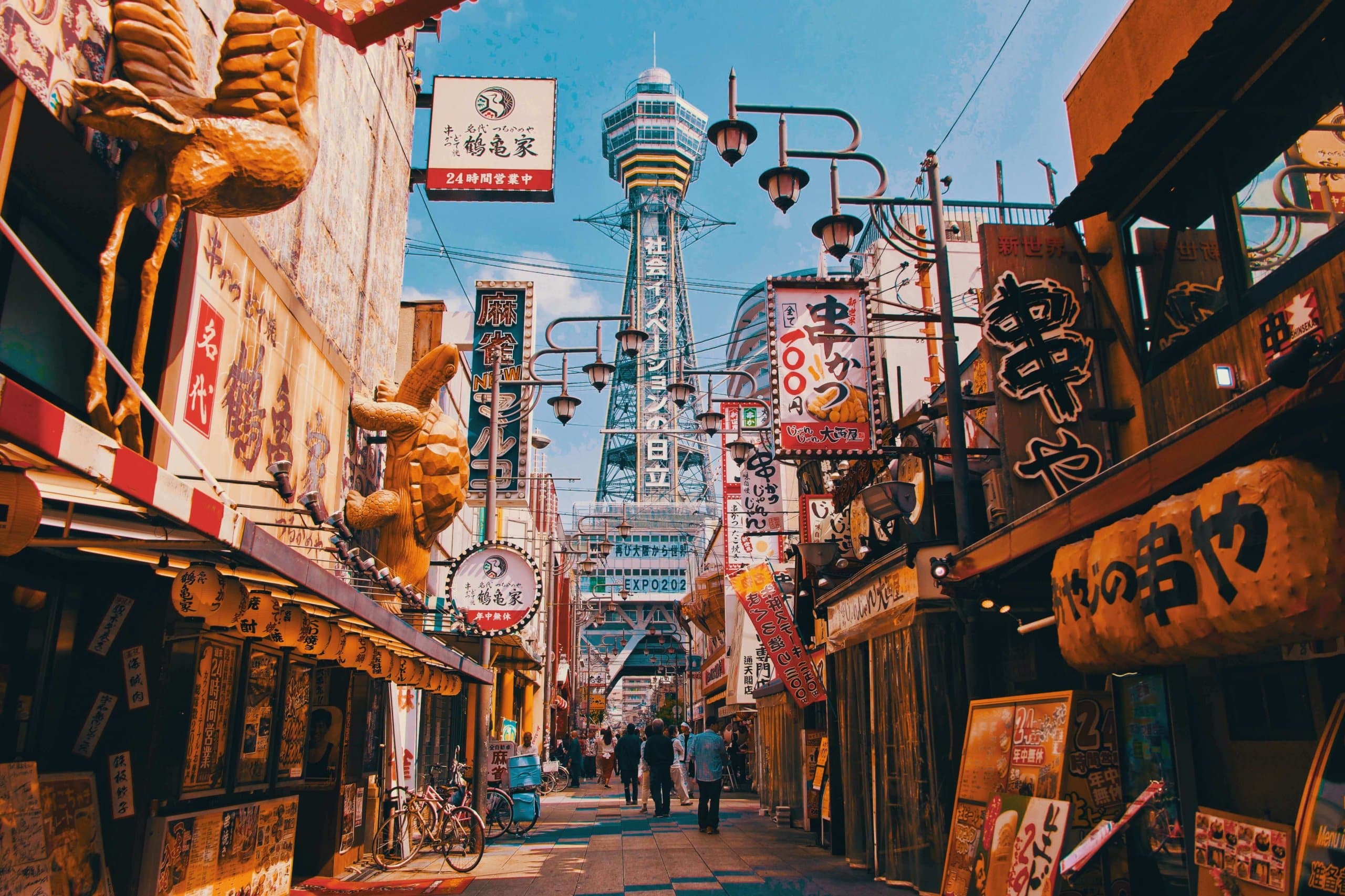
Shinsekai and kushikatsu: Head south to Shinsekai — a slightly retro, slightly rough-around-the-edges neighborhood built around the Tsutenkaku Tower — for kushikatsu: breadcrumbed, deep-fried skewers of meat, vegetables, and seafood dipped in a communal sauce. The rule: no double-dipping the sauce. Ever. I ate at a standing counter at a place so old the menu was barely legible and the owner refilled my beer without being asked.
Tsuruhashi: Osaka’s Koreatown, fifteen minutes from central Namba. Dense, aromatic, and completely overwhelming. I went twice. The yakiniku (Korean BBQ) here — grilling your own meat over a small charcoal grill at the table — is excellent value and the cuts of beef are exceptional. Go with someone to split more dishes.
Nakazakicho for coffee: A pocket neighborhood of renovated old townhouses now occupied by independent coffee shops, vintage clothing stores, and tiny galleries. Café Absinthe was my regular morning stop — pour-over coffee, a quiet table, and the strange pleasure of being somewhere that felt genuinely local.
What I’d skip: The upscale mall food courts in Shinsaibashi — fine for a snack but you’re in the street food capital of Japan. Eat outside.
What to Do
Osaka Castle: The castle itself is a 1930s concrete reconstruction of the original, which means the exterior is beautiful and the interior is a museum. The grounds — expansive, beautiful, full of cherry trees if you go at the right time — are worth more of your time than the building. Go in the morning, walk the moat, and sit on the ramparts.
Shinsekai: I mentioned it for kushikatsu but it deserves a longer visit. Built in the early 20th century to evoke Paris and New York simultaneously (it doesn’t, but the ambition is touching), it has aged into something genuinely characterful — pachinko parlors and old sento (public baths) and standing bars and the Tsutenkaku Tower, which is small and old and looks like it should be embarrassed by Tokyo Skytree but instead wears its age with dignity. Go in the afternoon.
Amerikamura (Amemura): The youth fashion district in Shinsaibashi — streetwear, vintage, independent labels. Smaller than Harajuku’s Takeshita Street but denser and more interesting. Triangle Park in the middle is where people gather to see and be seen.
Nakanoshima: A small island in the Dojima River between the two main city canals. Museum of Oriental Ceramics, a rose garden, the beautiful old Osaka City Central Public Hall. Peaceful in a way that feels like a different city from Dotonbori, which is a ten-minute walk away.
Sento (public baths): There are several traditional public bathhouses accessible to visitors in central Osaka. It costs around ¥500, requires you to understand the etiquette (separate male/female sections, shower before entering the bath, tattoo policies vary), and is one of the most quietly pleasurable experiences available. Azabu Juban Onsen in the Shinsaibashi area is a good option.
Day Trip: Nara (Highly Recommended)
Nara is 35 minutes from Osaka by express train. It contains Nara Park, where approximately 1,200 wild deer roam freely and have been designated “divine messengers” for 1,200 years. You can buy deer crackers and feed them. They will bow to request more crackers. This is real. It happens. The great Buddha at Tōdai-ji temple is genuinely awe-inspiring — the largest bronze Buddha statue in Japan, inside one of the world’s largest wooden buildings. Go on a weekday. Give it a full day.
Practical Notes
Getting around: Osaka’s subway system is straightforward. The Midosuji line (the red line) runs north-south and hits most of the main neighborhoods. A day pass (¥800) is worth it if you’re moving around a lot. Walking is very viable in the Namba/Shinsaibashi/Dotonbori area — everything is close.
Cash: Same as Tokyo — have cash. The covered markets like Kuromon are cash-only at many stalls.
Best time to visit: Osaka is good year-round. Cherry blossom season (late March–early April) is stunning around Osaka Castle but crowded everywhere. Summer is very hot and humid. I went in November — the light was beautiful, the air cool, and the city was in full autumn color.
Budget: Even slightly more affordable than Tokyo if you lean into street food and standing bars. Expect to spend ¥12,000–¥18,000 per day comfortably, less if you’re disciplined about eating at counters and markets.
The Honest Summary
Osaka feels like a city that’s comfortable in its skin. It doesn’t need you to be impressed by it. It’s going to carry on being exactly itself — loud at the canal, quiet in the back streets, impossibly good at food — whether you show up or not.
But you should show up. And you should stay longer than two days.
I went for seven days and my clearest memory is standing at a kushikatsu counter in Shinsekai at 10pm, sauce on my shirt, speaking no Japanese to a man who spoke no English, both of us silently agreeing through the medium of beer and fried skewers that we were having an excellent time.
That’s Osaka.
Article by Just a Lion · November 2024